
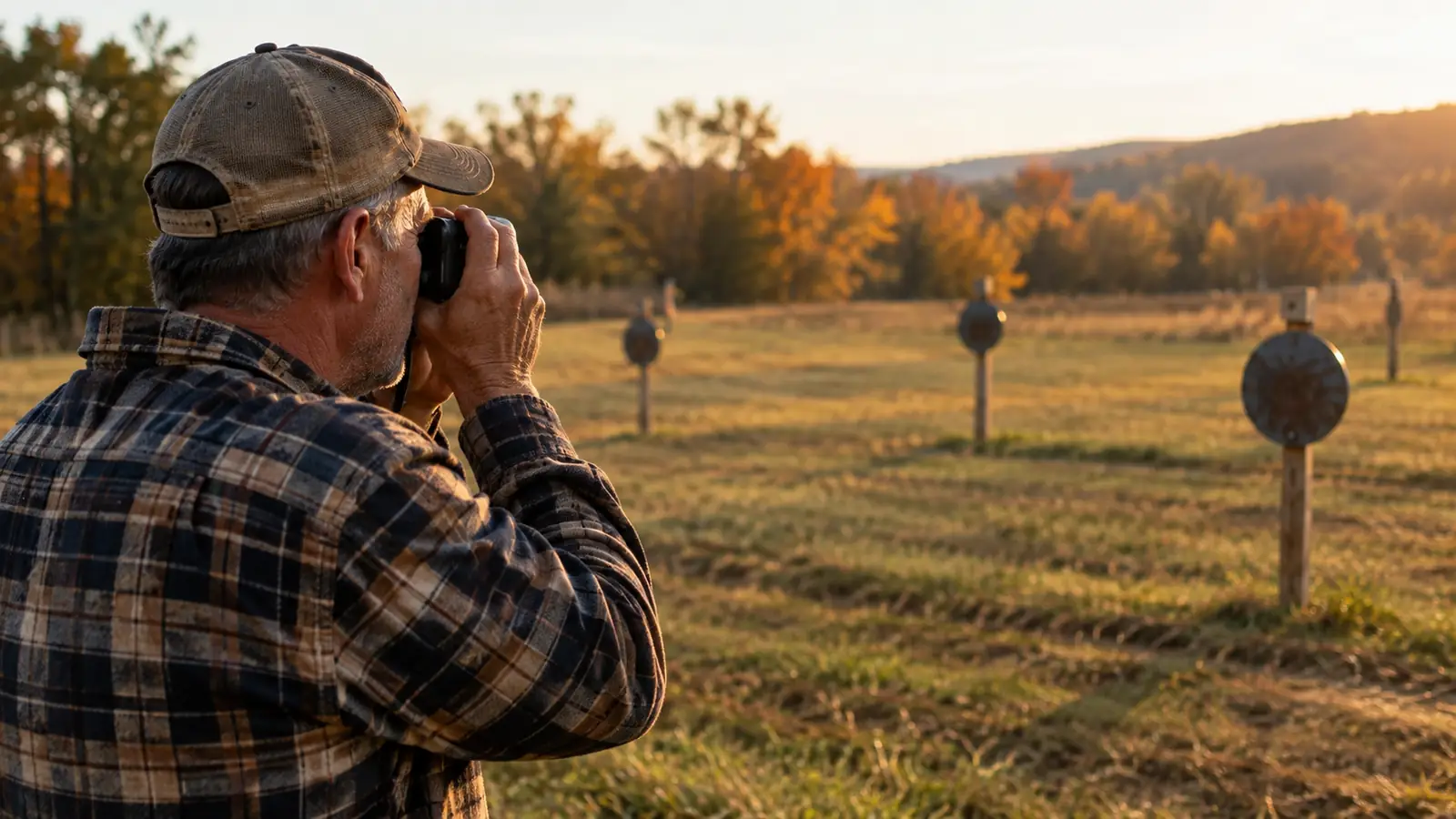
I spent my first twenty years in the deer woods guessing. I would see a buck working the edge of a cut cornfield, hold a little high on his chest, and hope I had judged the yardage right. Sometimes I was close. Sometimes I was not, and the times I was not usually ended with a deer walking off and me walking home trying to figure out where the shot went wrong. The problem was never the rifle. It was that I did not actually know how far away the deer was.
The fix is simple in theory, and it changed how I practice completely. You find out the real distance, then you train yourself to recognize what those distances look like from the positions you actually shoot from. That is what the TIDEWE Hunting Rangefinder does for me. I have the rechargeable 700/1000Y model, and after two seasons of practice sessions and one successful whitetail season, it has earned a permanent spot in my pack.
Know the Distance Before You Squeeze
The TIDEWE Hunting Rangefinder gives you a clear read on your target, so you can practice with purpose instead of guessing. Rechargeable, compact, and ready for the field.
Amazon Check Today's Price on Amazon →Why Distance Practice Matters
The math is simple. A whitetail's vital zone is about the size of a dinner plate. At 100 yards that looks generous. At 300 it looks like a postage stamp, and a guess that is off by 30 yards is the difference between a clean kill and a wounded animal. The whole point of distance practice is to shrink that error before you ever squeeze a trigger in the field.
And the rangefinder is the fastest way to train that skill. You do not need an expensive setup or a membership at a fancy range. You need a rangefinder, a few targets, and a place to shoot. The five steps below are the routine I have used for two seasons, and they work for a bolt gun, a lever gun, or a slug gun.
Step 1: Learn the Rangefinder Before You Trust It
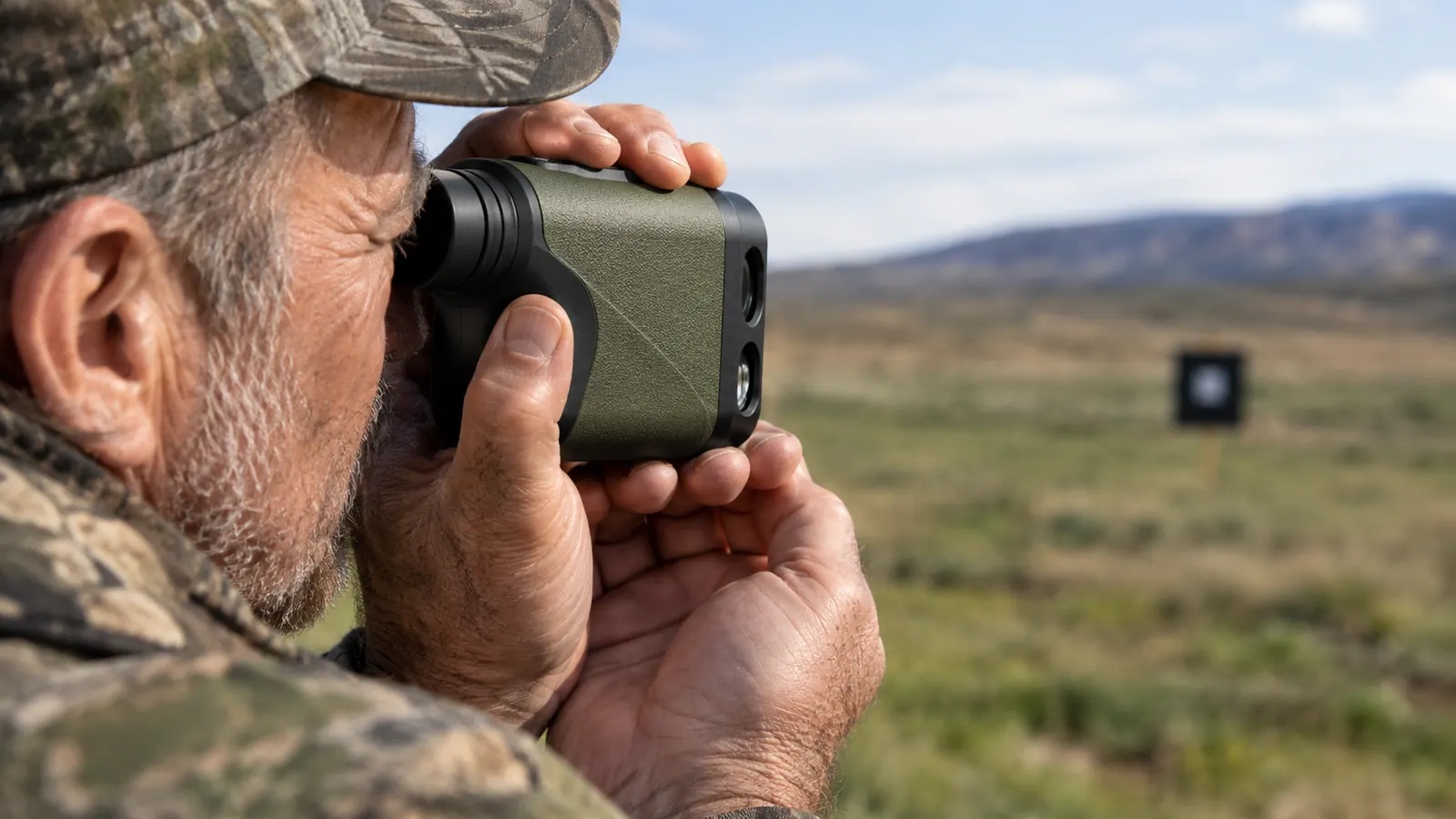
The first mistake most people make with a new rangefinder is pointing it at something and assuming the number is right. It usually is, but only if the rangefinder is set up for your eyes. The eyepiece on the TIDEWE focuses like a pair of binoculars. Turn it until the display inside is sharp, not just the target. If the numbers look fuzzy, you will misread them, and a misread number is worse than no number at all.
Then learn the buttons with the rangefinder in your hands, not in the dark on opening morning. The TIDEWE has a simple layout: a main button to range, a mode button to switch between single and scan, and a power button. Run through it a dozen times at the kitchen table. Press, read, clear, repeat. You want the motion to be automatic before you are standing in a cold wind with a buck in front of you.
Finally, test it on a distance you already know. Range the side of your barn, the neighbor's mailbox, the power pole down the road. If the rangefinder says 147 yards and your tape measure says 147 yards, you are in business. This is your baseline. Everything else builds on it.
Step 2: Set Up Targets at Known Distances
A practice range does not need to be fancy. I use a hayfield behind the house and a handful of steel gongs on T-posts. The key is that the distances have to be known. I set targets at 50, 100, 150, 200, and 300 yards, then I verify every one of them with the rangefinder before I shoot a single round. Yes, I measured with a tape for the first few. The rangefinder confirms what the tape says, and that confirmation is what trains your eye.
Paper plates work as well as steel if you are on a budget. Staple them to a cardboard target board and paint a dot in the center. The point is not the target. The point is that you know exactly how far away each one is, so when you look at a plate at 150 yards and then look at a plate at 200 yards, your brain starts building a reference library of what those distances actually look like.
Set targets at odd distances too, not just round numbers. A deer does not stand at exactly 100 yards. Put one gong at 137 yards if you can pace it out or range it. Practicing at odd distances is what makes the round-number practice useful.
Step 3: Build a Distance Card
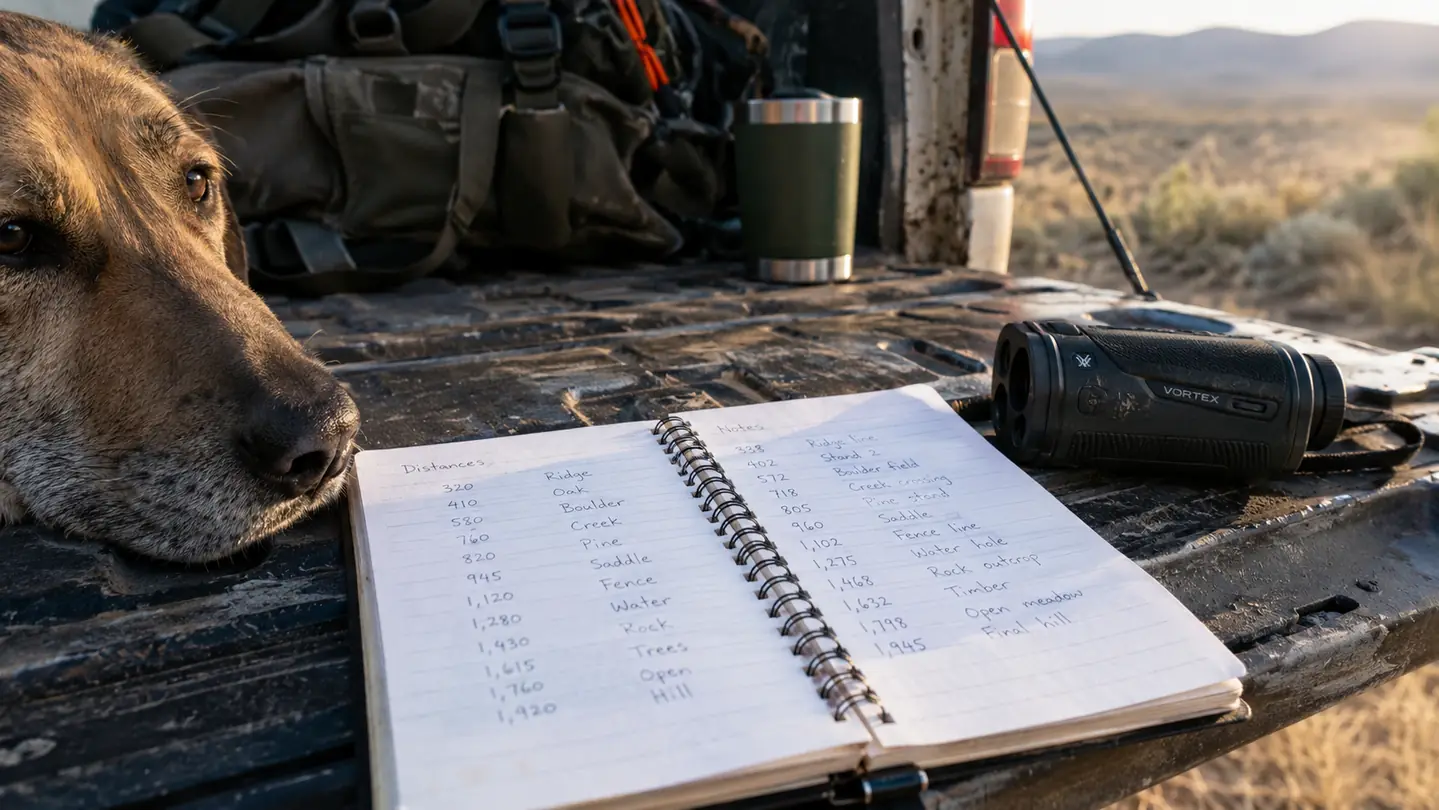
This is the step most shooters skip, and it is the one that pays off fastest. Keep a small notebook in your range bag, or tape a card to the inside of your gun case. Write down each target, its distance, and the conditions of the day. Light, wind, whether you shot from the bench or from kneeling. After a few sessions you will have a record of what 200 yards looks like in morning light, in flat light, in the thin air of late fall.
The card also keeps you honest. When you guess a distance and the rangefinder says you were off by 30 yards, write that down too. It is uncomfortable to see your misses in black and white. That discomfort is exactly why it works. The shooters who improve are the ones who can look at their own mistakes without flinching.
I keep my distance card in the truck, tucked behind the seat with my shooting log. The TIDEWE lives in the center console. When I am heading to the range, I grab both. The card tells me what to practice. The rangefinder tells me whether I am getting better.
Step 4: Shoot From Field Positions, Not Just the Bench
The bench is for sighting in. Practice is for everything else. If you only ever shoot from a bench rest, you are practicing a position you will never use in the field. Set up a shooting stick or a bipod, then work through standing, kneeling, and sitting positions at each of your known distances. Range the target from each position before you shoot.
Here is what you will learn: the distance does not change, but it looks different from three feet off the ground than it does from five. From kneeling, a 200-yard target looks farther than it does from standing. From a tree stand, it looks closer. The rangefinder keeps you honest because it tells you the truth no matter how your body is positioned. The number is the number.
This is where the TIDEWE earns its keep. It is small enough to stay in a chest pack or a jacket pocket, and the scan mode lets me range a target, adjust my position, and range it again without juggling buttons. That matters when you are trying to build muscle memory for a shot you might take from a weird angle in November.
Step 5: Guess First, Then Verify
The drill that improved my field shooting more than any other is simple: before you range a target, say your guess out loud. Then range it. Then compare. At first you will be off by 20 or 30 yards and you will feel foolish saying a number that is wrong. That feeling is the point. Your brain learns from the gap between what you guessed and what the laser says.
Over a few sessions, the gaps shrink. I started by missing 200-yard targets by 25 yards. By the end of the season I could call a 300-yard gong within 10 yards, and that is the difference between a shot that drops a deer and a shot that kicks up dirt behind it. The rangefinder is the teacher. Your eye is the student.
Run this drill in low light too, because that is when distances lie the most. Dusk flattens the landscape and makes everything look closer. Range the same targets at noon and at last light. The distances will not change, but what they look like will. Knowing that difference is what separates a hunter who guesses well from a hunter who knows.
What Else Helps
A rangefinder is a tool, not a magic wand. A few other things have made my practice sessions count. A good shooting rest is one. I use a simple bipod and a rear bag, nothing fancy. Consistent ammunition is another. If you switch loads between practice and hunting season, you are practicing with a rifle that is not the one you will carry.
Keep the rangefinder charged. The TIDEWE is rechargeable, which is convenient, but it also means you have to remember to plug it in the night before a hunt. I keep mine on the charger in the truck on the way to the field. If you are the type to forget, set a reminder on your phone. A dead rangefinder is just a heavy paperweight.
And finally, practice ranging things that are not targets. Range trees, fence posts, the far bank of a river, a duck on the water. The more you range, the better your eye gets, and the better your eye gets, the less you need the rangefinder in the moment. You will still carry it. You will just need it less.
The first time I ranged a buck at 287 yards, my guess was 240. The rangefinder did not just save that hunt. It rewired how I look at distance.
Where the TIDEWE Falls Short
No piece of gear is perfect, and the TIDEWE has its limits. The glass is good for the price, but it is not a premium unit that costs several times more. In deep twilight, when you are trying to range a deer in the last few minutes of legal shooting light, a top-shelf rangefinder will hold the target a little longer and read a little clearer. The TIDEWE will get you there most of the time, just not quite all of the time.
The rechargeable battery is a tradeoff. I like not buying replacement batteries, but a battery you cannot swap in the field is a real consideration if you hunt a week-long trip without power. I charge mine every night and it has never died on me, but I have thought about carrying a small power bank just in case.
And the button layout took me a few sessions to get used to. The mode button sits close enough to the main button that I hit the wrong one more than once in the early days. You will adapt to it, but plan on a learning curve the first time you take it out.
Who Should Buy It
If you are a deer hunter who shoots inside 300 yards, a turkey hunter who wants to know exactly how far that bird is, or a target shooter who wants to practice with purpose, the TIDEWE is a lot of rangefinder for the money. It is built for people who want a straight answer on distance without spending a fortune.
If you are a long-range precision shooter working past 700 yards, or someone who needs the best low-light glass money can buy, this is not the rangefinder for you. Look at the premium brands for that. But for the everyday hunter, the one who wants to practice distances the right way and know the number before the shot, it has been the right tool for me.
Practice With the Tool You Will Carry
The TIDEWE Hunting Rangefinder is the one I grab on the way to the field. Rechargeable, compact, and accurate enough for the shots most of us actually take.
Amazon Check Today's Price on Amazon →