

Nobody tells you the screen is three and a half inches until you open the box. The Garmin Striker 4 has sold by the truckload, and for good reason, but the first thing you learn is that you are not getting a chart plotter. You are getting a small, tough, honest sonar unit with GPS that will mark a waypoint and drop you back on top of it. It does that one job better than anything else I have used in its class. You have probably read a dozen reviews that call it the best budget fish finder on the market. That is true. What those reviews do not tell you is what that actually means on the water, so here is the straight story after two seasons of real use.
I am Wade Harlan. I fish a 16-foot aluminum boat on the lakes around Brainerd, Minnesota, mostly walleye in the spring and bass through the summer, and my yellow Lab Tucker rides along whether the fish are biting or not. Tucker is six years old, about 75 pounds, and he has opinions about which side of the boat to sit on, but he has never once complained about the electronics. I retired from the power company a few years back, so I have the time to be picky about gear and the budget to be careful with it. The Striker 4 has been on my gunwale since the ice went out last spring. It has been rained on, splashed, and left in the boat overnight more times than I care to admit, and it has never once failed to power up and show me the bottom.
The Quick Verdict
The best small fish finder I have used, as long as you accept the small screen and the blank GPS map. It marks fish, marks structure, and keeps working. It just will not show you a lake map or talk to your phone.
Amazon Check Today's Price →If you want a simple sonar unit that just works, this is it.
The Garmin Striker 4 does one job and does it well. See today's price and current availability on Amazon.
Amazon Check Today's Price on Amazon →How I've Used It
I mounted the Striker 4 on the port side of the tiller, up high enough that Tucker does not knock it with his tail when he turns around, which is roughly every time a gull flies over. It has also sat on the dash of my old pickup with the topper for a week at a stretch. Most of my fishing is within a mile or two of a public ramp on lakes I have known for thirty years. I know where the humps are. What I wanted from a fish finder was a second set of eyes to show me how deep the water is, where the weeds end, and whether fish are holding on a break.
That is exactly the job this unit does. I run the 77 kHz setting when I want to see the whole water column and the 200 kHz setting when I want a sharper look at the bottom, and both are a button press away. The CHIRP sonar is not a marketing label. It shows weeds, rock piles, and the occasional arch that is almost certainly a walleye holding tight. I have marked fish with this unit that I would have motored right over, and I have also watched it show me nothing in water I know holds fish. No fish finder on earth finds fish for you. This one tells you what is under the boat, and the rest is up to you.
The buttons are the part nobody talks about. There is no touchscreen, and that is a feature, not a bug. I run the unit with cold hands, wet hands, and once with a pair of insulated gloves so thick I could barely feel the throttle. The buttons are big and spaced well enough that I can change the gain without looking away from the water for more than a second. That matters more to me than a bigger screen ever would.
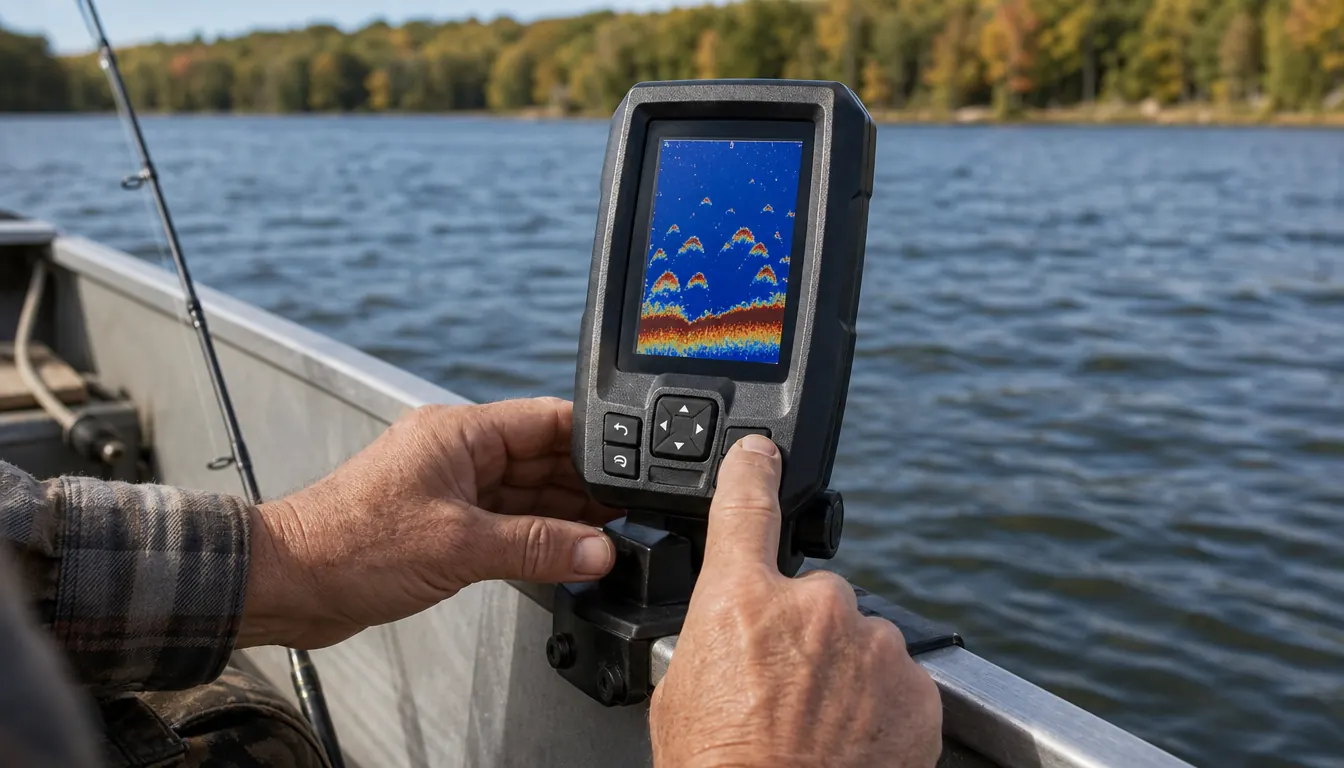
The 3.5-Inch Screen Is the Whole Story
Here is the honest part, and it is the part most reviews dance around. The screen is small. Three and a half inches sounds fine in a spec sheet, and then you mount it on a boat that rocks and try to read it in direct sun, and you realize you will be leaning in to look at it. The display is bright enough and the backlight helps, but there is no way around the size. You get one main view at a time. You can split the screen between sonar and GPS, but then everything gets tiny, so I mostly run a full sonar view and switch to GPS when I need it.
What surprised me is that the size matters less than I expected. Once I set the gain and learned what the returns looked like, I stopped staring at the screen and started glancing at it. A quick look tells me the bottom is dropping from twelve to eighteen feet, and I know the break is coming. You do not need a big screen to tell you that. You need a screen you can read at a glance. The Striker 4 is readable. It is just not big, and you should know that before you buy it, not after.
What the Sonar Shows and What It Doesn't
The CHIRP sonar in the Striker 4 is the real thing. On the lake it shows weeds, rock piles, and the occasional fish arch holding tight to the bottom, and it does it without a lot of fiddling. Out of the box, the picture was good enough to fish within an afternoon. I spent the first trip adjusting the gain until the clutter disappeared, and after that I have barely touched it. The unit remembers my settings when I power it down, which sounds like it should be obvious but is not true of every fish finder I have owned.
Now the other half. The transducer that comes in the box is a transom mount, and it has held up fine, but you have to dial it in. The cable is long, which is good for routing, but if you do not secure it, it will slap against the hull at speed. Once I got the angle right, I held bottom at trolling speed without trouble. At planing speed it will lose the bottom now and then, and that is normal for a transom mount on a small boat. When I want a good look, I slow down. That is the tradeoff, and it is a fair one, but it is worth knowing before you drill holes in your transom.
It has been rained on, splashed, left in the boat overnight, and sat on the dash of my pickup for a week. It keeps working.
Mounting It So It Stays Put
The mount in the box is a simple tilt mount with a ball joint, and it works. I bolted mine to the gunwale and it has not moved in two seasons. The one piece of advice I will give you is to spend twenty minutes routing the power cable and the transducer cable before you turn anything on. If you just drape them, they will get stepped on, chewed on, or yanked. Tucker has stepped on mine exactly once, which is how I learned to tuck the cable under the gunwale rail.
Power comes from a 12-volt battery, which means you either have one on the boat already or you need to plan for it. I run mine off the same small battery that runs my trolling motor, and I have never had an issue with the draw. The unit does not have an internal battery, so it is not something you toss in a backpack and use on a pond without a little thought. For my boat, that is not a problem. For someone who wants a handheld unit, it would be, and it is worth knowing before you order.
What Nobody Tells You About the GPS
The GPS in the Garmin is accurate and fast, and it will mark waypoints and track your path. Here is what nobody tells you: there is no map behind it. The screen is a blank grid until you start driving the boat and building your own picture. You do not get lake contours, you do not get depth labels, you do not get the lake name. You get a dot that shows where you are and lines that show where you have been. That is all. For a lot of people, that is a surprise, and for some, it is a dealbreaker.
For me, that turned out to be fine, because I fish lakes I already know. I marked a weed line in May, and in August I can still find it. I marked a rock pile that only breaks the surface in a dry year, and the Garmin put me back on it every time. But if you fish big water where you need contours to find structure, or if you are used to a phone app that shows the whole lake, this unit will frustrate you. The waypoints live in the unit. There is no app, no card slot, no way to get them out. What is in there stays in there, so keep the unit safe.
What I Would Change, and the Alternatives I Considered
If I could change one thing about the Striker 4, it would not be the screen size. It would be the way the unit handles waypoints. You can mark a spot, name it, and save it, but managing a long list of waypoints on a three-and-a-half-inch screen is slow. You scroll, you select, you scroll some more. It works, and I have never lost a waypoint, but it is not a pleasant way to spend an evening. I keep my list short and my names simple, like rock pile or weed line, and that helps.
The second thing I would change is the power cable. The one in the box is long enough, but the inline fuse holder is the weakest part of the whole kit. Mine vibrated apart last summer, and I replaced it with a proper marine fuse holder. That is a ten-minute fix, not a reason to avoid the unit, but it is the kind of thing a year of reviews will not tell you.
Before I settled on the Striker 4, I looked hard at the Humminbird PiranhaMAX 4 and the Lowrance Hook2 4x. Both are good units, and both have their fans. What pushed me to the Garmin was the GPS. A lot of fish finders at this level are sonar only, and the ones with GPS cost more or have a smaller screen. The Striker 4 gives you both without loading you up with features you will never use. I know guys who run 10-inch screens on boats the same size as mine, and they love them, but they also treat them like fine china. I would rather have a small unit that takes a beating and is easy to replace if something happens to it.
Who This Is For
Buy the Striker 4 if you fish a small boat or a kayak, if you fish lakes you already know, or if you want a simple sonar unit that shows depth and fish without a learning curve. Buy it if you want to leave a fish finder on the boat all season without worrying about an expensive screen getting soaked or stolen. It is also a good first fish finder for a young angler, because it is hard to break and easy to understand. If that sounds like you, this unit will do what you ask of it for years.
Who Should Skip It
Skip it if you need a map. If you fish big water and rely on contour lines to find structure, the blank grid will drive you crazy. Skip it if you want to see your phone, share waypoints, or run side imaging, because this unit does none of that. And skip it if a small screen will annoy you every single trip, because no amount of value makes up for a screen you cannot stand to look at. There are bigger Garmin units that do more. They cost more, and for some people that is the right call. For everyone else, the little Striker 4 is the honest choice.
The Bottom Line
Two seasons in, the Garmin Striker 4 is still mounted on my boat, still powering up on the first try, and still telling me what is under the hull. It is not a big-screen chart plotter, and it does not pretend to be one. It is a simple, honest fish finder with GPS that does its job without drama. It is not the fanciest tool on the lake, and it does not pretend to be that either. If you know what it is going in, you will be happy with it. If you expect more, you will be disappointed. I know which side I am on, and I would buy it again tomorrow.
What I Liked
- CHIRP sonar is clear and easy to read once you set the gain
- Buttons are glove-friendly and simple to use in rough water
- GPS waypoints are accurate and hold their position
- Built tough, rain and splashes have not bothered it
- Flasher mode means it works for ice fishing too
Where It Falls Short
- 3.5-inch screen is genuinely small in direct sun
- No preloaded maps, no contours, blank grid until you make your own
- No Wi-Fi, no app, no way to export waypoints
- Transducer needs careful setup and loses bottom at planing speed
- Needs a 12-volt battery, no internal power
The honest take: buy it for what it is, not what it is not.
If you want a simple, tough sonar unit with GPS that does its job season after season, the Garmin Striker 4 is hard to beat. Check today's price and availability on Amazon.
Amazon Check Today's Price on Amazon →